Margins in road transport are notoriously thin. A 2–3% miscalculation on tolls, multiplied across dozens of trips per month, quietly eats the profit out of your operation. The problem is that estimating tolls accurately is genuinely hard: rates differ per country, per road, per vehicle, and per kilometer driven within each country.
This guide walks you through why toll costs are difficult to estimate manually, what parameters actually drive the calculation, and how to get an exact figure for any European route in seconds with Transport Nomad.
Why estimating tolls "by feel" doesn't work
Five variables make manual estimation unreliable:
1. Each country charges differently
Tolls in Germany, Austria, Switzerland, France, and Spain are calculated on completely different bases. Germany uses a per-kilometer rate (Maut) that depends on emission class and CO2 group. Austria sells digital GO-Boxes with distance-based pricing. Switzerland has a heavy vehicle fee (LSVA) that combines weight, distance, and emission class. France charges at toll booths with rates per motorway segment. There's no single formula that works across borders.
2. Route composition changes the total
The single biggest source of error is assuming "average European toll cost per km." Two routes with the same total distance can differ by 20–30% in toll costs depending on which countries you drive through and for how many kilometers.
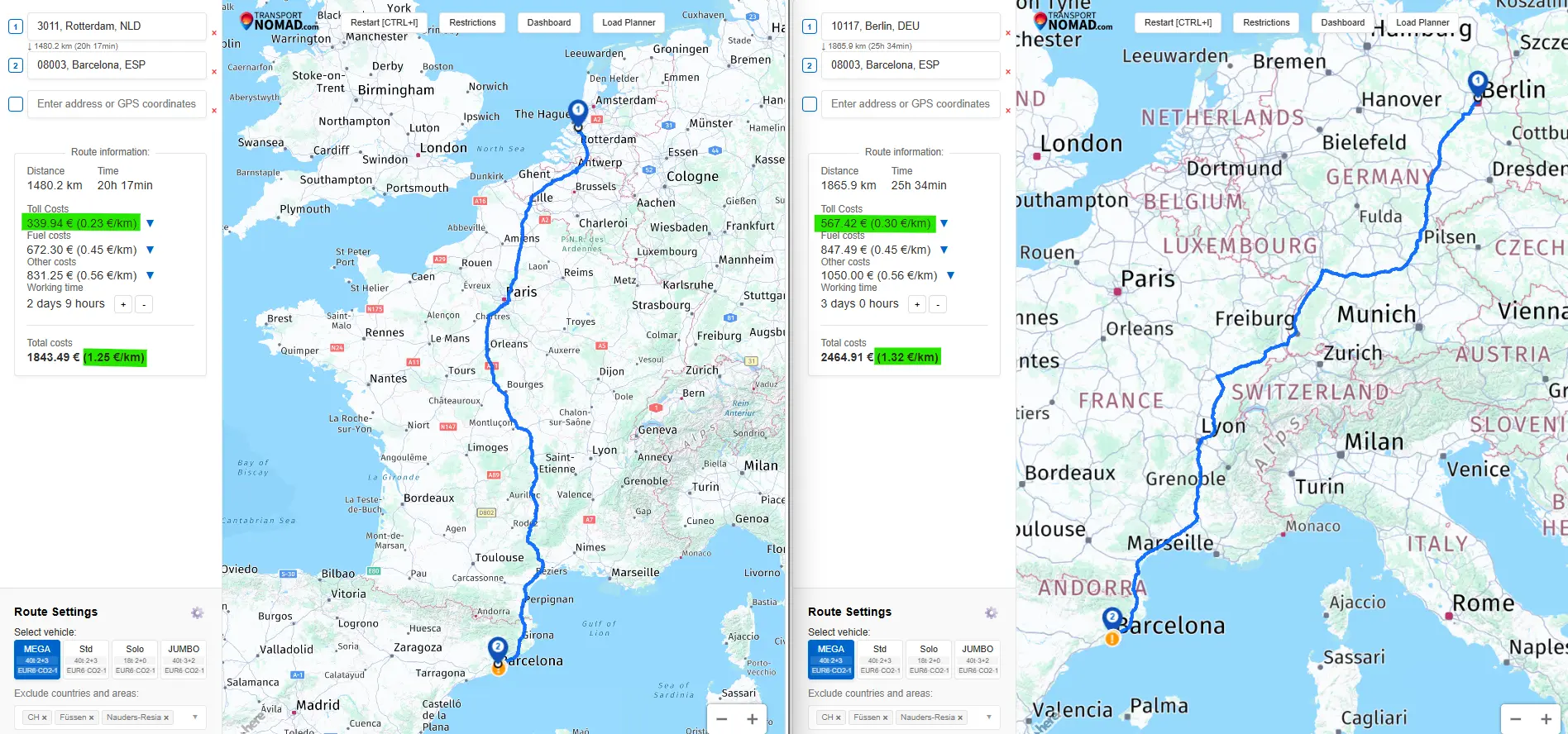
Consider two routes ending at the same destination, Barcelona:
- Route A: Rotterdam → Barcelona via NL/BE/FR/ES. The toll-free Netherlands and Belgium stretches reduce the cost base; France makes up the bulk of toll kilometers.
- Route B: Berlin → Barcelona via DE/FR/ES. German Maut applies across hundreds of kilometers before the truck even reaches France.
For a typical 40-tonne 2+3-axle EURO 6 combination, Transport Nomad currently calculates around €0.25/km in average toll cost on Route A versus €0.31/km on Route B. That's about a 24% difference per kilometer driven. Across the full route it adds up to hundreds of euros, purely depending on where the truck enters France.
Without exact per-country breakdowns, you can't quote either route reliably.
3. Vehicle parameters change everything
Toll rates depend on:
- Gross weight (GVW/DMC). Most countries have brackets like 3.5–12 t, 12–18 t, 18–32 t, 40 t+.
- Number of axles. Typically 2, 3, 4, 5+ axles, each in its own pricing tier.
- EURO emission class. EURO 5 vs EURO 6 can change German Maut by tens of euros per 100 km.
- CO2 class. Since 2024 Germany factors in a CO2 emission class on top of the EURO standard, and it's now one of the biggest swing factors.
Upgrading the fleet from EURO 5 to EURO 6 or moving to a better CO2 class can cut German tolls by 15–25% on a long route. If you're quoting without these parameters dialed in, your number is a guess.
4. Tunnels and ferries are separate
The Brenner Pass, the Gotthard Tunnel, the Channel Tunnel, the Mont Blanc Tunnel: each charges its own fixed fee for trucks, often €100–300 per crossing depending on vehicle size. Ferries on Baltic, Adriatic, or North Sea routes add hundreds of euros and shift the time-vs-cost trade-off. There is no realistic way to memorize all of this for every route.
5. Rates change frequently
National toll authorities adjust rates at least annually, sometimes mid-year. Germany alone has revised Maut twice in the past 24 months. If your spreadsheet still uses 2024 rates, you're underquoting or overquoting on every trip without realizing it.
What you actually need to enter in Transport Nomad
Instead of tracking all of this manually, Transport Nomad needs four pieces of information about your vehicle, set up once per truck:
- Gross weight (GVW): total maximum permitted weight, in tonnes. Found on the registration certificate.
- Number of axles, including trailer axles for combinations.
- EURO emission class (EURO 3 through EURO 6, or EURO VI for heavy duty).
- CO2 emission class (class 1 through class 5), assigned based on the vehicle's CO2 emissions profile. New trucks delivered since 2024 carry this on the registration; for older vehicles, your manufacturer or fleet manager can confirm.
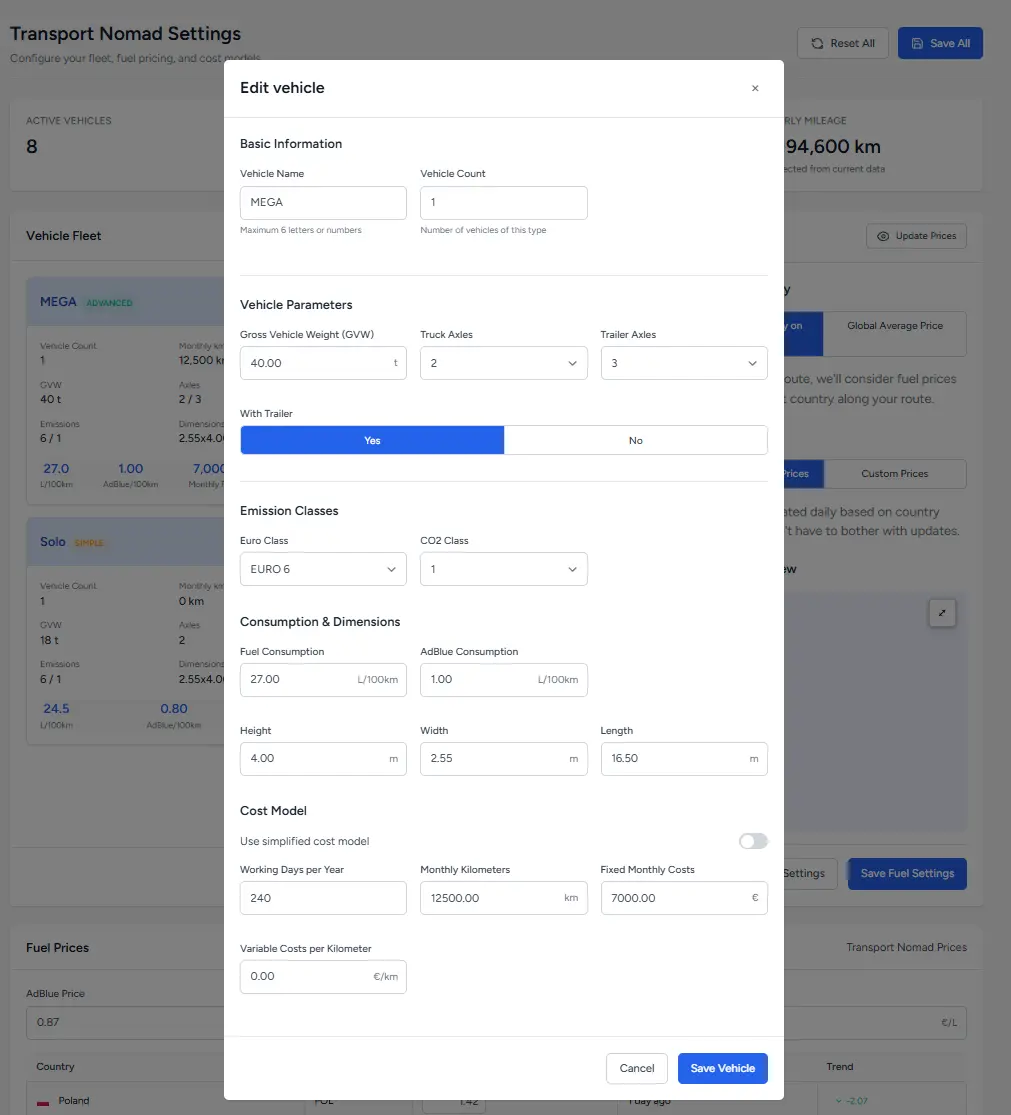
Once these parameters are set, every route you plan automatically uses them. No per-trip configuration.
How Transport Nomad calculates the total
When you enter a route, Transport Nomad:
- Generates the actual road path through each country, kilometer by kilometer.
- Applies the official current toll rate for each country segment, using your vehicle's exact parameters.
- Detects tunnels and ferries on the route and adds their crossing fees.
- Returns a per-country breakdown so you can see exactly which leg of the journey costs what.
The per-country split is the part most worth paying attention to. When you can see that one route burns €180 on German Maut while another adds €60 in tunnel fees, you can make informed routing decisions instead of estimating averages.
Equally important: Transport Nomad keeps toll tables current. When Germany or France adjusts rates, your next route plan reflects the new rates automatically. No spreadsheet updates required.
A practical comparison
Coming back to the two Barcelona-bound routes from earlier, for a 40-tonne 2+3-axle EURO 6 combination the average per-kilometer toll cost looks like this:
| Route | Avg toll cost per km | Where the cost concentrates |
|---|---|---|
| Rotterdam → Barcelona (NL/BE/FR/ES) | €0.25/km | French péages |
| Berlin → Barcelona (DE/FR/ES) | €0.31/km | German Maut + French péages |
Rates current at the time of writing. Transport Nomad updates them automatically.
The headline difference is €0.06/km, which doesn't sound dramatic on paper. On a 1 800 km trip that's over €100, and multiplied by dozens of trips per month, a misquote on a single lane can swing a fleet's monthly margin meaningfully. And this is just the per-kilometer cost; the totals also differ because Route B is longer.
The point: the same shipment to Barcelona costs noticeably more in tolls depending on whether the origin sits in Germany or in the NL/BE/FR corridor, and that difference scales with every kilometer.
Practical tips for accurate quoting
A few habits that prevent toll-related quote disasters:
- Calculate per actual route, never per average. "About €X per kilometer" estimates are wrong for almost every trip.
- Recalculate when planning routes for new vehicles. A different EURO or CO2 class can shift quotes meaningfully even on familiar lanes.
- Include tunnels and ferries explicitly in the cost. They're often the deciding factor on Alpine and Mediterranean routes.
- Re-check long-term customer rates twice a year. Standing contracts based on old toll rates lose money fast when authorities adjust prices.
Summary
Manual toll estimation in modern European transport is a losing game. There are too many variables and the rates change too often. Setting your vehicle parameters once in Transport Nomad and letting the system calculate the exact toll for every route turns a routine source of margin erosion into a precise, reliable cost line.
Set up your vehicle once → plan any route → see exact per-country tolls, tunnels, and ferries within seconds.
See it on your own route. Start the free 14-day trial, set your vehicle up once, and the toll line on your next quote matches the roads your truck will really drive.