Fuel is the single biggest variable cost in any transport operation. A 40-tonne tractor burning 28 litres per 100 km over a 1 500 km trip uses about 420 litres of diesel, and depending on whether the driver fills up in Luxembourg or France, the bill can swing by €40-50 on that single tank. Multiply by a fleet, multiply by a year, and the cumulative cost of fuelling badly stops being a rounding error.
This guide covers why fuel prices vary so much between European countries, how those differences translate into real planning decisions on multi-country routes, and how Transport Nomad automatically picks the cheapest fuel along the way so you do not have to track 27 national price tables.
Why country prices diverge
Three forces drive the country-to-country gap:
- Base wholesale price. Different importation costs, distribution networks, and competitive intensity. Even neighbouring countries can have meaningfully different pump prices before any tax is applied.
- VAT rate. Every country sets its own. Going from a 19% to a 25% VAT country means a meaningful price step for non-recoverable scenarios.
- Excise duty. The big one. Each country sets its own road-fuel tax, and the spread between low-excise countries (Luxembourg, Spain) and high-excise ones (Germany, Italy, the Netherlands) is often €0.15-0.25 per litre.
On top of that, several countries run excise refund schemes for professional hauliers. France's "gazole professionnel" refund, Spain's "gasóleo profesional", Italy's quarterly rebate, and Belgium's similar system can claw back a chunk of the excise, but only if your operation qualifies and you actually file. Whether you participate in the refund changes which country is "cheapest" for you in practice.
So the answer to "which country has the cheapest diesel" is not one number. It depends on your VAT recovery status, your refund participation, and the day you ask.
What this means on a multi-country route
Consider a route from Antwerp to Milan. The truck crosses the Netherlands, Germany, Luxembourg, France, and either Switzerland or France into Italy via Mont Blanc. Each country presents a different pump price for the same driver and the same vehicle.
A planner who does not track this either ignores the question entirely (filling up wherever the driver feels like), or follows a habit ("we always fuel in Luxembourg"). The habit was probably right at some point, but fuel prices shift, and what was true two years ago may no longer be.
The right approach is to calculate the cheapest fuelling stop for every actual trip, factoring in current prices in each transit country, your refund status, and your vehicle's tank capacity (no point routing through "cheap" Luxembourg if the driver cannot reach it without topping up sooner anyway).
How Transport Nomad handles it
When you plan a route in Transport Nomad, the system:
- Computes the actual road path through each country.
- Looks up the current diesel price for each country on the route, using the market data Nomad keeps up to date.
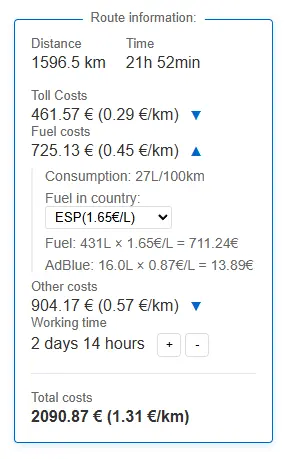
- Identifies the cheapest sensible fuelling stop given your trip profile and bakes that price into the trip's fuel cost.
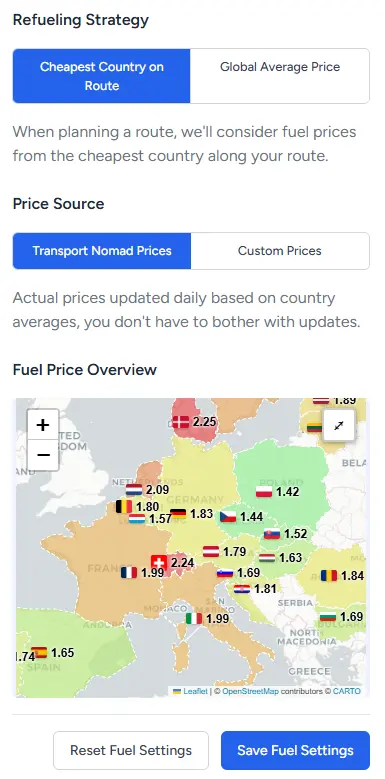
You do not have to remember whether Belgium or Luxembourg is cheaper this month, whether the German rate just went up, or how Italy's excise has shifted. The number in your route cost reflects what the truck would actually pay if it fuelled in the cheapest reasonable place along the way.
Prices change constantly, your plan should too
Fuel pricing is genuinely dynamic. Take a Brussels-to-Milan run through Luxembourg and Austria. Today Luxembourg might be the obvious cheap-fuel stop. Three months from now, after an Austrian excise adjustment or a Luxembourg tax change, Austria could undercut it. A planner working from last year's spreadsheet would consistently route fueling to the wrong country.
Transport Nomad's country price tables update with the market, so every fresh route plan reflects the situation right now, not the situation when the spreadsheet was last edited. You do not have to track these changes; the system does it for you.
When fixed prices fit your operation better
The automatic cheapest-fuel logic suits long-haul international work where the truck genuinely refuels along the route. It is not the right answer for every operation.
Carriers that run out-and-back regional work and always refuel at the home depot do not care which country is cheapest on the road. The truck is not going to stop and buy diesel mid-route. For those operations, Transport Nomad lets you set a fixed global fuel price applied to every trip. The cost calculation then uses that flat number regardless of where the route passes.
The same logic applies to fleets fuelling exclusively from a private depot tank: you already know your actual cost per litre delivered to the tank, so use that number directly rather than country averages.
Custom prices per country for your fuel-card reality
The country averages Nomad ships with are a sensible default. But every carrier's real cost per litre is different from the country average because:
- Fuel cards come with negotiated discounts off the pump price, and those vary wildly between issuers and contract sizes.
- Preferred station networks mean you fuel at a specific brand most of the time, and that brand may sit above or below the national average.
- Excise refund participation can reduce effective cost by €0.10-0.20 per litre, but only for carriers who file the paperwork, which not everyone bothers with at low volumes.
For tighter accuracy, you can override Nomad's country averages with your own per-country prices. Every route plan after that uses your actual cost structure, not a market average. The difference compounds across a year of trips, and on a large fleet it is the gap between knowing your margin and guessing it.
The vehicle side: realistic consumption
Fuel cost on a route is price per litre × litres consumed, and the consumption side is set per vehicle. Transport Nomad asks for an average consumption in litres per 100 km.
The point of using a single per-vehicle figure is to balance accuracy with practicality. A more elaborate model (consumption varying with terrain, weather, load weight, driver style) would add hours of setup per vehicle and give marginally better answers. A flat L/100 km is precise enough that an old Volvo at 32 L/100 km comes out clearly more expensive per kilometre than a newer MAN at 24 L/100 km, calculated against the real route and the real fuel prices, in a fraction of a second on the Transport Nomad map.
This is the same trade-off the rest of the cost model takes: enough specificity to reflect your fleet, simple enough that you actually set it up and use it.
Summary
Fuel pricing in European transport is too volatile and too country-dependent to track manually. Base prices differ, VAT and excise differ, refund schemes differ, and they all change constantly. Transport Nomad keeps the price tables current and picks the cheapest sensible fuelling stop for every route automatically, while letting you override with fixed prices or your own fuel-card rates when that fits your operation better.
Set consumption once per vehicle, decide whether you want country-aware or fixed pricing, optionally enter your own per-country prices, and every route plan after that uses fuel costs grounded in today's reality and your operation's actual structure.
See it on your own route. Start the free 14-day trial, plan a multi-country trip, and see where fuelling is cheapest today — with your fuel-card prices if you enter them.