Walk into any truck stop in Europe and look at the trailers parked there: most of them are roughly the same size. 13.6 metres long, 2.5 metres wide, somewhere between 2.7 and 3.0 metres tall on the inside. That uniformity isn't a coincidence. It's the result of a tight set of legal limits and decades of industry convention that funnel almost every trailer into one of a handful of shapes.
The 3D Load Planner ships with 10 ready-made vehicle templates covering those standard shapes, and a custom-dimensions option for everything that falls outside them. This guide explains what each standard is, where its numbers come from, and how to pick the right one for your load.
The 10 standard templates
| Template | Length | Width | Height | Typical payload |
|---|---|---|---|---|
| Standard | 13.62 m | 2.48 m | 2.70 m | ~24 000 kg |
| MEGA | 13.62 m | 2.48 m | 3.00 m | ~24 000 kg |
| Frigo | 13.31 m | 2.46 m | 2.65 m | ~24 000 kg |
| JUMBO | 15.90 m (2 × 7.70 m) | 2.48 m | 3.00 m | ~22 000 kg |
| SOLO | 7.70 m | 2.48 m | 3.00 m | ~18 000 kg |
| Container 20' | 6.06 m | 2.44 m | 2.59 m | up to 28 000 kg |
| Container 40' | 12.19 m | 2.44 m | 2.59 m | up to 28 000 kg |
| Container 40' HC | 12.19 m | 2.44 m | 2.90 m | up to 28 000 kg |
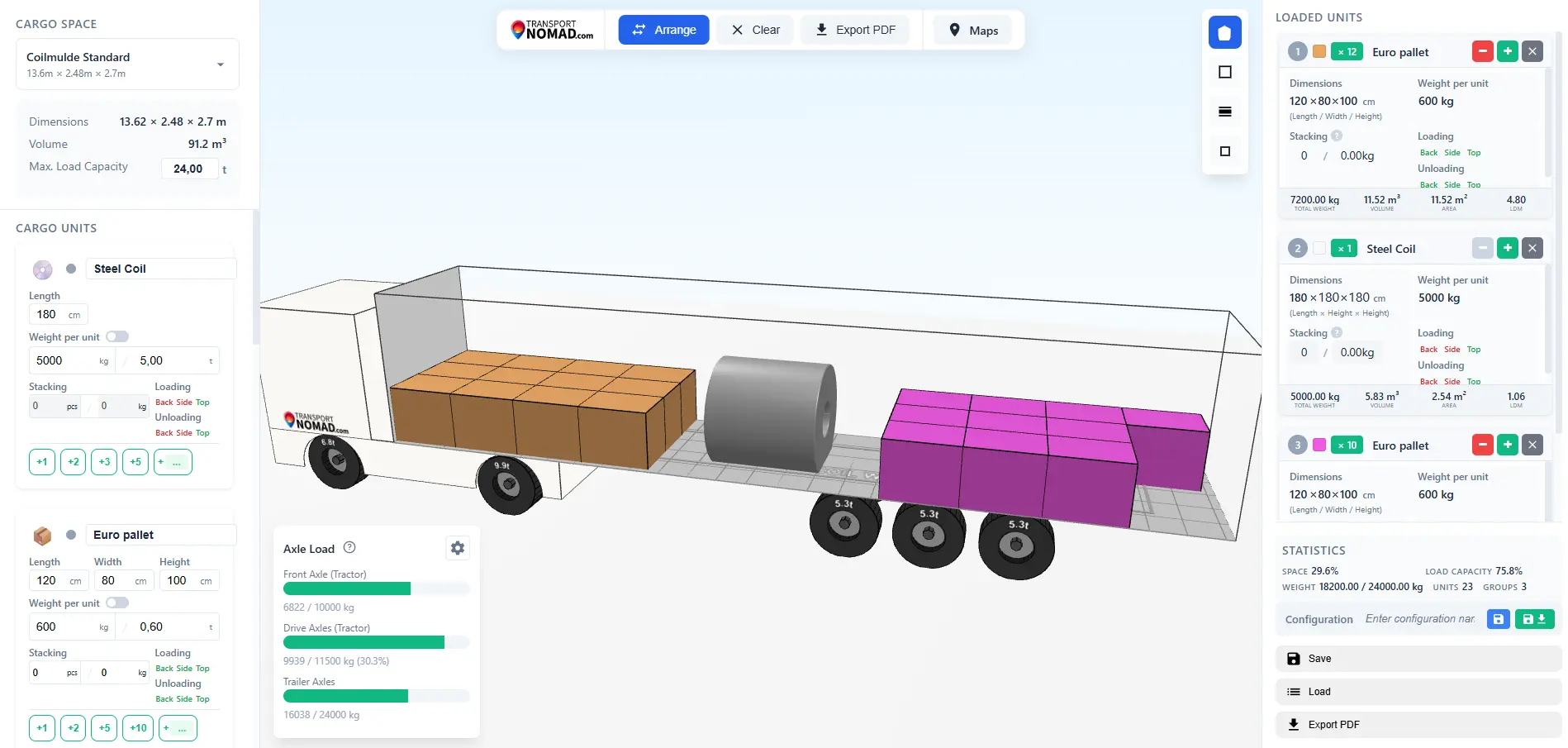
| Coilmulde Standard | 13.62 m | 2.48 m | 2.70 m | ~24 000 kg |
| Coilmulde Mega | 13.62 m | 2.48 m | 3.00 m | ~24 000 kg |
The payload column shows typical figures, not fixed trailer properties. On EU roads, the real maximum is the 40-tonne gross limit (44 tonnes for intermodal) minus the combined empty weight of your tractor and trailer. A modern lightweight Euro 6 tractor coupled to a light trailer can carry 25 tonnes or more; an older or heavier combination might be limited to 22 tonnes. Container values are different again: 28 tonnes is the ISO structural rating relevant for sea and rail intermodal, but on the road the same 40-tonne combined limit applies. The Load Planner uses indicative values out of the box and lets you override them per vehicle when you know your real empty weights.
Picking any of these in Transport Nomad is a single click. Open the cargo-space dropdown, choose a name, and the Load Planner fills in the dimensions, payload defaults, and axle configuration automatically. No measuring tape, no remembering whether a Frigo is 13.31 or 13.42 metres, no looking up which container variant is the high-cube. The standards are already in there, packaged behind one menu.
Why these dimensions are "standard" in the first place
European trailer sizes are not the product of trailer manufacturers choosing freely. Three sets of rules collapse the design space into a narrow corridor.
EU road dimensions (Directive 96/53/EC and successors): a tractor + semi-trailer combination cannot exceed 16.5 metres in total length, 2.55 metres in width, 4.00 metres in height, and 40 tonnes gross weight (44 tonnes for intermodal). Subtract the tractor cabin, the chassis floor height, and the kingpin clearance from those limits and you get roughly 13.6 metres of usable length, 2.48 metres of usable width, and 2.7 to 3.0 metres of usable height inside the trailer. Every Standard, MEGA and Frigo in Europe lives inside this box.
EUR pallet sizes (ISO 6780 and EUR/EPAL): the European pallet is 1.20 × 0.80 metres. The Industrial (chep) pallet is 1.20 × 1.00 metres. Trailers got optimised around fitting whole numbers of these. 13.6 m of usable length holds 33 EUR pallets in three rows of eleven, or 26 industrial pallets in two rows of thirteen. The dimensions you see in the table are not random; they are tuned to fit the pallets that the industry actually moves.
ISO container standards (ISO 668, dating back to 1968): the 20' / 40' / 40' HC family was defined for global sea, rail and road interoperability. The width (2.44 m, slightly narrower than European trailers) and the corner-casting positions are fixed worldwide. European trailers and ISO containers ended up with different external widths because each was optimised for a different ecosystem.
The result is that the same combinations show up everywhere: Standard for almost everything, MEGA for volumetric loads, Frigo for cold chain, containers for intermodal, JUMBO for the truck-plus-trailer combination that EU law allows up to 18.75 m total. Once you've planned a few loads in the Load Planner, the templates start to feel obvious.
The everyday three: Standard, MEGA, Frigo
These three cover the bulk of European long-haul. Same external footprint, payload in the same general range, three different internal heights chosen for three different cargo profiles.
Standard is the default curtainsider, 2.70 m tall inside. It's the trailer that arrives when an offer doesn't specify otherwise. If you don't have a specific reason to pick anything else, this is the one.
MEGA is the same trailer with the floor dropped and the roof raised, giving 3.00 m of internal height. Worth choosing when pallets are stacked tall, when loading automotive bodies, drums, or any cargo that "almost fits" a Standard but would require crushing the top layer.
Frigo is the refrigerated unit. Length, width and height are all slightly smaller than Standard because the insulation walls and the cooling unit eat real space. Those few centimetres matter when the load is planned tight: a pallet stacked to 2.70 m clears a Standard roof but not a Frigo's 2.65 m, and a plan built against 2.48 m of width sits a couple of centimetres too wide at 2.46 m.
JUMBO: the truck-plus-trailer combination
JUMBO is fundamentally different from the rest. It's not one trailer, it's two cargo bodies: a 7.70 m truck section coupled to a 7.70 m trailer section, with a 0.5 m gap in the middle. Total usable length 15.90 m.
This combination exists because EU law allows truck + drawbar trailer combinations up to 18.75 metres total, longer than the 16.5 m limit on tractor + semi-trailer. The trade-off is two separate loading compartments instead of one, which is brilliant for volumetric loads and harder to optimise for dense cargo. The Load Planner draws JUMBO as two distinct sections so you can plan each independently.
SOLO: the rigid truck
SOLO is a single rigid truck without a trailer: 7.70 m cargo body, 3.00 m height. Short wheelbase, manoeuvrable, gets into places a semi-trailer cannot. City distribution, restricted-access deliveries, short shuttle runs. Its lower gross weight rating also means less payload than a full combination, which is fine because SOLO jobs are usually below that ceiling anyway.
If your offer is a single drop in a town centre or to a construction site, SOLO is often the only legal option. It's also the right pick for jobs that don't justify the cost of a full 13.6 m trailer when the cargo only fills half of it.
The container family: 20', 40', 40' HC
The three container templates follow ISO standards exactly. The choice between them comes down to density and height:
- 20' for heavy, dense cargo where you hit the weight limit before filling the volume.
- 40' for normal-density cargo and most international sea freight, the workhorse of intermodal.
- 40' HC when the cargo is tall. The extra 31 cm of height (2.90 m vs 2.59 m) unlocks loads that wouldn't fit under a standard container.
On the road, container loads compete for the same 40-tonne combined limit as everything else, so the ISO 28-tonne rating only fully applies in sea and rail intermodal.
Coilmulde: the specialist for steel
The two Coilmulde templates look like ordinary trailers from the outside but have a longitudinal groove built into the floor for carrying steel coils. A coil placed across the trailer drops partly into the groove, which prevents it from rolling. Without the groove you'd need wooden cradles, chains, and an hour of securing per coil. With it, the coil sits stable and you strap it down.
Coilmulde Standard and Coilmulde Mega differ exactly the same way Standard and MEGA differ: 2.70 m vs 3.00 m internal height. Pick the Mega version if the coils are tall enough that the dunnage on top of them would scrape a 2.70 m roof.
What "13.62 m" actually means
The dimensions in each template are internal usable values, not catalogue specs. A trailer maker advertises "13.6 metres" because that's the loadable length between the front wall and the rear doors. Real curtainsiders give back a centimetre or two to side belts; Frigo units lose more to the cooling vent at the front. The Load Planner uses what you can actually fill with cargo.
The same logic applies to height. A Mega trailer in a brochure might be 4.00 m tall overall (floor at 1.0 m + 3.0 m internal). The Load Planner only cares about the 3.0 m of internal cargo space, which is what your pallets compete for.
When standard isn't enough: custom dimensions
Standards cover most of European haulage, but not all of it. There are perfectly legitimate trailers and combinations that don't fit any of the 10 templates:
- Extended trailers allowed in Sweden and Finland under the EMS system, up to 25.25 m long
- Special-purpose trailers like car transporters, low loaders, open platforms, drop-side trailers
- Refrigerated containers (45' HC, reefer variants) used in specific trade lanes
- Older or regional designs still in operation but no longer in catalogues
- Custom-built trailers for specific industries: glass, livestock, tankers, walking floors
For all of these, the Load Planner has a custom-dimensions option. You can either start from one of the templates and override length, width, height, or max payload, or define a cargo space from scratch. The 3D view, the cargo placement and the PDF report all work the same way once the dimensions are set.
The general rule: if the trailer roughly matches one of the templates, start from that template and tweak. If it's something completely different (a low loader, a tanker, an open platform), build it from scratch.
A simple decision tree
If you're not sure which template to pick, work through it like this:
- Steel coils? Coilmulde Standard or Mega, depending on coil height.
- Temperature-controlled? Frigo.
- Cargo over 2.70 m tall? MEGA for 2.71–3.00 m, JUMBO if you also need length and the cargo is light.
- Single drop, city or short haul, max 18 t? SOLO.
- Sea or rail intermodal? Container 20' / 40' / 40' HC, picking by density and height.
- Anything that doesn't fit a template? Custom dimensions.
- Everything else? Standard.
Most jobs are "everything else" and the answer is Standard. The specialist templates exist because the specialist jobs need them. Picking the right one when you have a coil or a refrigerated load saves the planner from flagging your plan as unsafe.
What this means for your money
The template choice is where a mispriced trip starts. Quote a MEGA-height load into a Standard, and the second vehicle you send afterwards costs more than the whole margin. Plan a stack height against a Standard roof and load it into a Frigo, and the top layer comes back off at the dock, on your driver's hours. Picking the right cargo space costs one click and settles the question before the price goes out.
Summary
European trailer sizes look standard because they are: a small number of shapes fitting inside the legal limits on length, width, height and weight, optimised around the pallet and container standards the industry uses. The 10 templates in the 3D Load Planner cover the vast majority of jobs you'll plan. The custom-dimensions option covers the rest. Pick the right starting shape before placing pallets, and the load plan stays grounded in what your trailer can actually carry.
Next in this series: how the 3D Load Planner handles cargo units (EUR pallets, industrial pallets, IBCs, steel coils, custom boxes) and what their stackability rules mean for the plan.
See it on your own load. Start the free 14-day trial, pick your trailer from the template list, and check whether tomorrow's cargo actually fits before you commit on the exchange.