A 1 200 km route from Lyon to Milan can cost three very different amounts depending on whether you cross the Alps via Mont Blanc, Fréjus, the Brenner Pass, or detour through Switzerland. The kilometres are similar; the crossings are not. Mont Blanc and Fréjus charge per axle, Brenner is a regular toll, Switzerland involves the LSVA on top. Add a Channel Tunnel leg or a Baltic ferry to a longer trip and the picture gets even more uneven.
This guide covers how Transport Nomad detects tunnels, rail shuttles, and ferries on any planned route, how it asks for your actual price (not a generic guess), and how it folds the crossing into the total trip cost so you can compare routing options at a glance.
What Nomad detects on a route
When you draw a route in Transport Nomad, the system scans the path for non-road segments and infrastructure that charges a fixed fee:
- Tunnels with truck tolls (Mont Blanc, Fréjus, Gotthard road tunnel, and the rest).
- Rail shuttles for trucks (Eurotunnel Le Shuttle Freight, Italian truck auto-train services).
- Ferries for road freight (Calais-Dover, Hook of Holland, Baltic crossings, Adriatic routes, Mediterranean lines).
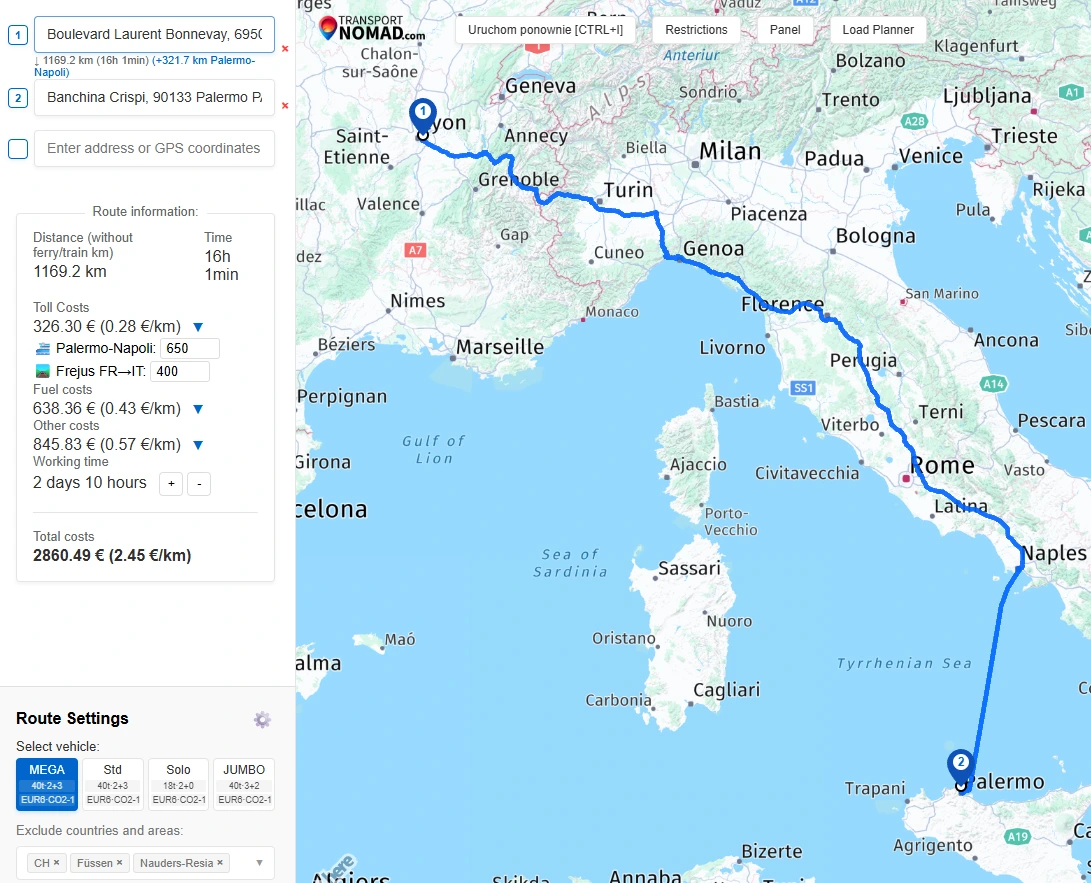
For each crossing detected, Nomad displays the relation name (for example, "Mont Blanc tunnel" or "Calais → Dover ferry") and opens a small prompt asking for the price your operation pays for that specific crossing.
Why we ask you for the price instead of supplying one
Crossing prices are not posted rates that a single number would capture. The reality:
- Per-truck pricing at major tunnels depends on vehicle class, axle count, and weight category.
- Volume agreements mean a haulier crossing Mont Blanc 200 times a year pays substantially less than a one-off operator. A frequent user might pay €250 for a crossing where an occasional customer is quoted €320.
- Partner programmes offer further discounts at certain operators, while others do not.
- Ferries vary by route, season, time of day, vehicle dimensions, accompanied versus unaccompanied, and the carrier's commercial relationship with the shipping line.
Any "average" price Nomad shipped with would be wrong for most carriers. Instead we ask you for the price you actually pay, once. Nomad remembers it in your browser's local storage and reuses it every time the same crossing appears on a future route.
If your rate changes (volume bracket shift, new partner agreement, seasonal ferry pricing), you update it once and every subsequent route reflects the new number.
Comparing crossing options on the same trip
This is where the crossing logic earns its keep. Take Lyon to Milan. You have at least four serious options:
- Mont Blanc tunnel
- Fréjus tunnel
- Brenner Pass (longer in distance but no tunnel fee, just standard tolls)
- Switzerland via the Gotthard (different toll structure plus LSVA)
In a spreadsheet, comparing these means manually pulling fuel for each route length, tolls per country, and the crossing fee per option, then summing the columns and hoping you did not miscount a kilometre. In Transport Nomad you drag the route through the option you want to evaluate, and the total cost recomputes immediately, crossings included.
Drag the route again through a different pass. Different total. Pick the cheapest, or the one that matches your driver's hours, or the one that avoids a known problem corridor. The trade-off is visible in seconds.
Kilometres on a ferry or train do not count as driving
A detail that catches people manually splitting trip costs: when a truck spends 35 minutes inside Eurotunnel or 12 hours on a Baltic ferry, those kilometres are not driven. No fuel is burnt and no toll is paid for that segment.
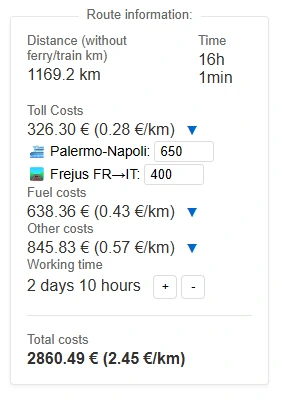
Transport Nomad handles this automatically. Distance covered on a rail shuttle or a ferry is excluded from the fuel consumption calculation and from country-by-country toll computation. The only cost attributed to that segment is the crossing fee you set.
In the trip cost breakdown you see this cleanly separated:
- Fuel cost. Based on driven kilometres only.
- Toll cost. Based on driven kilometres only, per country.
- Crossing costs. The prices you set for the tunnels, ferries, or rail shuttles on this route.
No need to subtract "the ferry portion" from anything by hand. The system already did it.
Multi-stop routes with multiple crossings
Real European haulage often combines several crossings in one trip. Hamburg to Dublin via the Netherlands and a ferry. Athens to Munich with both Italian and Adriatic segments. A Morocco run over the Algeciras–Tanger Med crossing.
Transport Nomad treats every detected crossing on a multi-stop route as its own line. If you go through Mont Blanc on leg 1 and take the Calais-Dover ferry on leg 3, you get prompted for both prices (each only once, even if a future trip reuses them), and the total trip cost includes both.
For carriers running stable routes, this means the second time you plan a Hamburg-Dublin trip, every crossing price is already remembered. You drag the route, and the total is right.
Summary
Tunnels, rail shuttles, and ferries are the part of European routing where naive €/km models fall apart most visibly. The prices are operator-specific, carrier-specific, and route-specific, and any single average would mislead most carriers most of the time.
Transport Nomad's approach is to detect every crossing automatically, ask you for your real price once, remember it, and then include it in every relevant route cost from then on. Distance on ferries and rail shuttles is correctly excluded from fuel and toll maths. The result is a clean cost breakdown that lets you compare Mont Blanc against Fréjus against Brenner in seconds, instead of spreadsheets and coffee.
See it on your own route. Start the free 14-day trial, plan a trip with a crossing, enter your price once, and every future route over that line is costed at your rate.