Most carriers price routes the same way: take a rough average €/km from last year's books, multiply by trip distance, add a margin, send the quote. It works on the easy lanes and quietly loses money on the hard ones. The root cause is that "average €/km" hides the structure of transport costs, and the structure matters more than the average.
This guide walks through the right model, fixed costs versus variable costs, and how to enter your vehicle setup so Transport Nomad applies that model to every route automatically, calibrated to your specific operation.
The two cost buckets
Every transport cost falls into one of two buckets:
- Variable costs scale directly with kilometres. Drive more, spend more; drive less, spend less. Fuel and tolls are the textbook examples.
- Fixed costs stay the same regardless of distance driven. Office rent, driver salary (paid whether the truck moves or not), leasing instalments, depreciation. They cost the same whether the vehicle does 9 000 km this month or 13 000 km.
The variable side is mostly mechanical. Transport Nomad already calculates tolls per country, per axle count, per EURO and CO2 class, and fuel based on consumption × distance × current price. You set the fuel price and consumption once, the system handles the rest per route.
The fixed side is where most carriers misprice their work.
Why fixed costs need a "per-kilometre" treatment too
Fixed costs are paid monthly or yearly, but every quote needs a per-trip number. The bridge is the expected annual mileage of the vehicle.
A typical European tractor unit has about 240 working days per year (52 weeks × 5 days, minus holidays and downtime). Those 240 days are when the vehicle earns. The rest of the year, the fixed costs still accrue (leasing, salary, office) but nothing is being driven.
So if a vehicle does 10 000 km per month on average, that's 120 000 km annually, spread across 240 working days = 500 km per working day on average. If your fixed costs add up to, say, €120 000 per year, that's €500 of fixed cost per working day, or €1.00 per kilometre of fixed-cost recovery built into every kilometre the truck drives.
This per-kilometre fixed-cost figure is what makes per-trip pricing accurate. Without it, you're quoting just the variable side and silently paying the fixed side out of your margin.
The 700 km example
Imagine the same 700 km route done two different ways:
- Truck A finishes in 1 day. Variable costs (fuel + tolls) hit normally. Fixed costs absorbed: 1 working day × €500 = €500.
- Truck B drives the same route but takes 1.5 days (loading wait, slow border, suboptimal route). Variable costs are roughly the same, the kilometres haven't changed. Fixed costs absorbed: 1.5 days × €500 = €750.
The €250 difference is real money the operator loses on Truck B, even though both trucks "did the same trip." With a flat €/km model, both quotes would look identical. With a fixed + variable model that accounts for time spent, you can see where the margin actually went.
Transport Nomad does this maths automatically when your vehicle profile has fixed costs and working-day assumptions configured.
What to set up on each vehicle
Three numbers per vehicle, entered once:
- Average monthly kilometres. What this vehicle realistically does in a typical month. City distribution vehicles will be lower (4 000–6 000 km); long-haul tractors much higher (10 000–14 000 km). Use last year's data if you have it.
- Annual fixed costs. Sum of: leasing, driver salary including social charges, insurance, depreciation, the vehicle-attributed share of office overheads, scheduled maintenance, parking. Take it from accounting and divide it across fleet vehicles however your company already does.
- Working days per year. Defaults to 240, which is the typical European pattern (52 weeks × 5 days, minus holidays and downtime), but it is meant to be adjusted to your operation. Seasonal carriers, businesses with rarely-used vehicles, or fleets standing idle for part of the year will be lower (180–200). Operations that genuinely run the fleet on weekends in addition to weekdays will be higher (270+). There is no industry-correct number, only the one that matches your company.
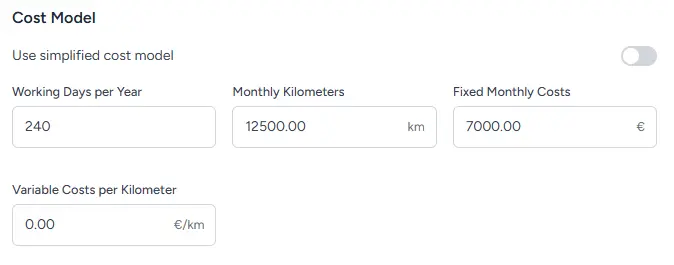
For fuel, two more numbers per vehicle:
- Fuel price per litre. Transport Nomad ships with country-average prices that track the market, and you can use those out of the box. But for tighter accuracy, override with your own: every carrier has its own fuel-card discount level, preferred station network, and excise-duty recovery situation (some operations qualify for the refund, others do not because their volumes are too low to be worth filing). Real per-litre cost is almost always different from the country average, and the gap compounds across a year of trips.
- Consumption in litres per 100 km.
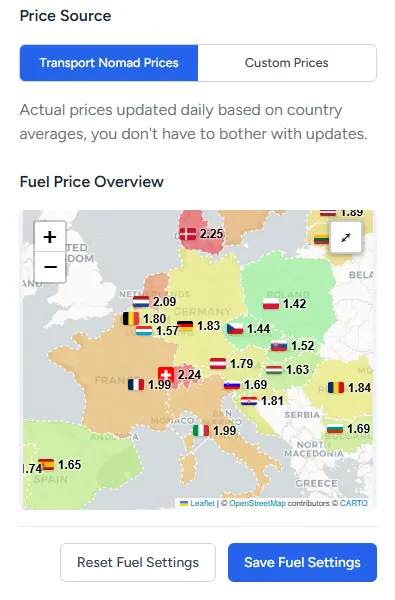
Tolls are handled entirely by the system based on the route, vehicle parameters, and country-by-country rates that Nomad keeps up to date. No extra setup needed.
How it shows up on a trip
With the vehicle correctly set up, every route plan shows you both layers:
- The variable line: actual fuel + actual tolls for this route, kilometre by kilometre, country by country.
- The fixed-cost line: this trip's share of the fixed costs, based on the driving time it occupies of the truck's annual capacity.
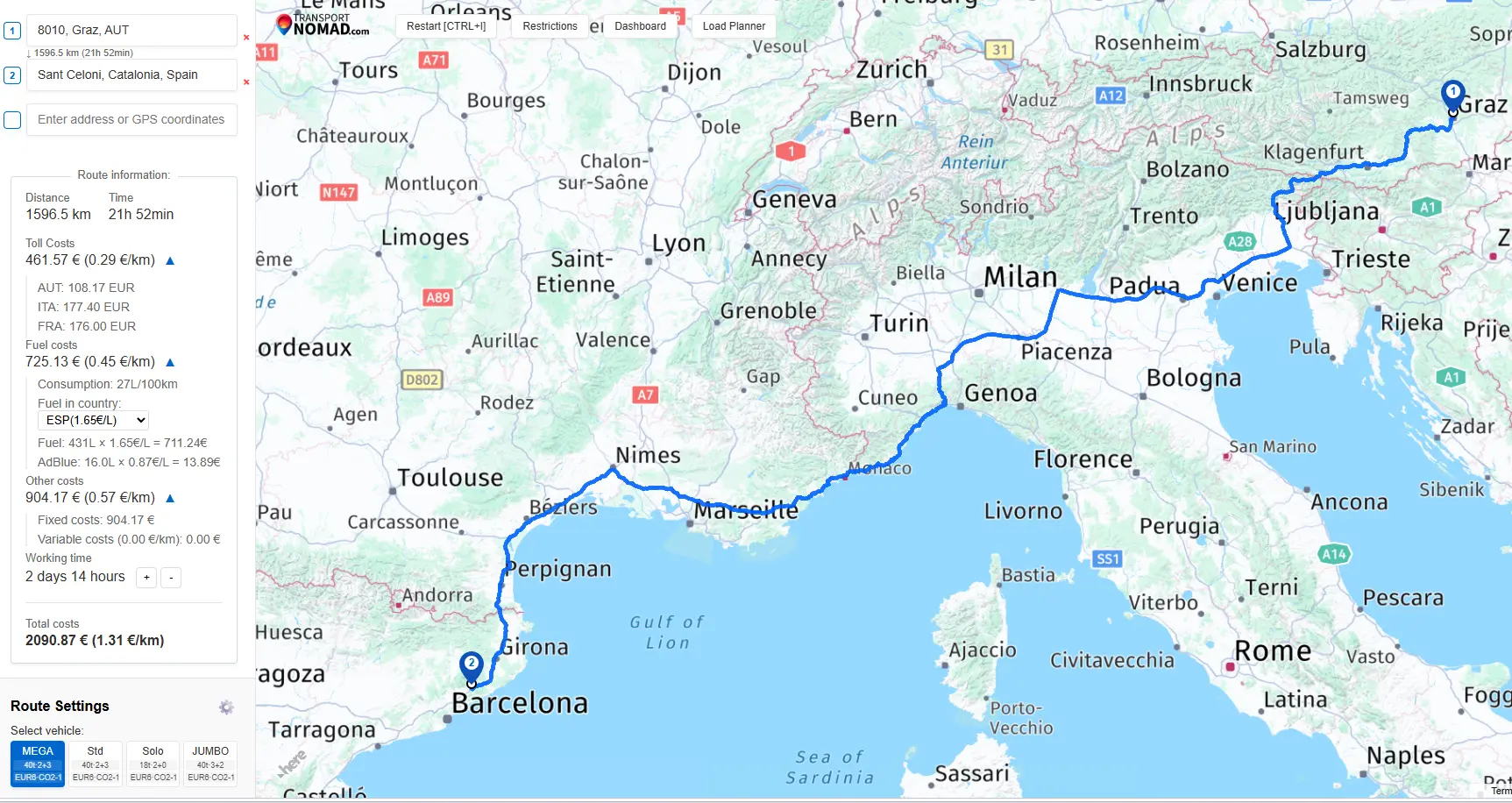
The headline number is the true cost of the trip. You add your margin on top of that, not on top of a guess.
Why per-company calibration matters
City distribution and long-haul transport are not the same business. City distribution does fewer kilometres per day but more stops and more standing time; long-haul covers a lot of ground but spends most working hours at speed. The cost-per-kilometre profile of a delivery van is wildly different from a 40-tonne international tractor.
Transport Nomad doesn't assume a single industry average. By taking your monthly kilometres + fixed costs + working days per vehicle, the system calibrates to your specific operation. No two carriers run identical books, so no single benchmark would be right. The setup takes a few minutes per vehicle and then quietly underpins every quote.
Grey-area costs: just pick a side
Some costs don't cleanly fit either bucket. Tyres are the classic example: they wear from kilometres driven, but also from age and weather. Whether you treat tyres as fixed (a quarterly tyre budget per vehicle) or variable (€ per 100 km consumed) is a judgement call, and reasonable people disagree.
Transport Nomad doesn't take a side. Put tyres into the annual fixed-cost figure, or build them into the per-kilometre consumption-style cost, whichever fits how you already think about your books. Either way, the trip-level cost ends up correct because the same euros are recovered against the same kilometres, just labelled differently.
The same applies to AdBlue, minor consumables, and small workshop items. Pick the bucket once, stay consistent across the fleet, move on.
Summary
The single biggest pricing mistake in transport is treating €/km as one number. The reality is fixed costs plus variable costs, and the split depends on your vehicle, your operation, and your year's working days. Set those three numbers per vehicle, let Transport Nomad calculate fuel and tolls automatically, and every quote you generate uses the true cost of the trip, not a comfortable approximation that loses money on the half of trips below average.
Five minutes per vehicle, once. Then every route plan after that includes both the variable line that scales with distance and the fixed-cost recovery that keeps the fleet profitable across the year.
See it on your own fleet. Start the free 14-day trial — five minutes per vehicle, and every quote after that carries your real fixed and variable costs.